DIN 933
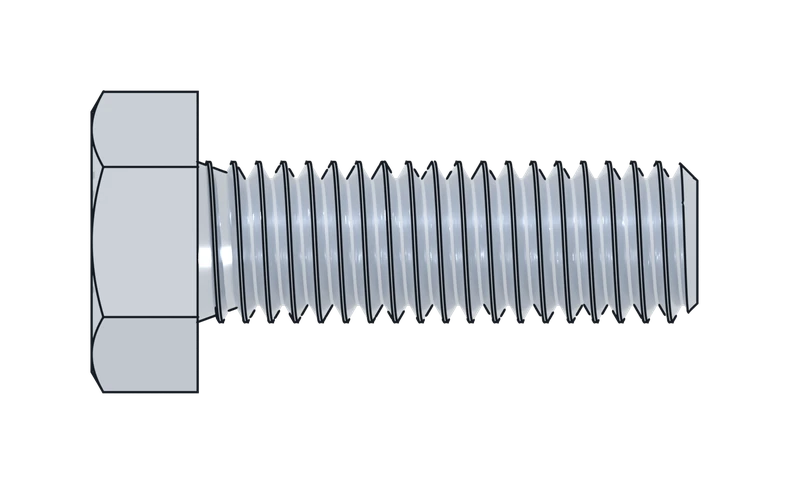
Hexagon head screw,threaded up to the head


| Size | P (mm, coarse) | s (mm, nom.) | e (mm, min) | k (mm, nom.) | dw (mm, min) | Break (kN, min) | Torque (N·m, µ 0.14) |
|---|---|---|---|---|---|---|---|
| 0.70 | 7.00 | 7.66 | 2.80 | 6.20 | 7.0 | 3.3 | |
| 0.80 | 8.00 | 8.79 | 3.50 | 7.20 | 11.3 | 6.6 | |
| 1.00 | 10.00 | 11.05 | 4.00 | 8.88 | 16.1 | 11.3 | |
| 1.25 | 13.00 | 14.38 | 5.30 | 11.63 | 29.3 | 27.3 | |
| 1.50 | 16.00 | 17.77 | 6.40 | 14.63 | 46.4 | 53.9 | |
| 1.75 | 18.00 | 20.03 | 7.50 | 16.63 | 67.4 | 93.1 | |
| 2.00 | 24.00 | 26.75 | 10.00 | 22.49 | 125.3 | 229.9 | |
| 2.50 | 30.00 | 33.53 | 12.50 | 28.19 | 203.2 | 464.0 |
Values per ISO 4017:2022. Breaking load per ISO 898-1; torque per VDI 2230, µ = 0.14.Differs from DIN 933
Work out the screw length you needOpens the bolted joint configurator with DIN 933 / ISO 4017 chosen.Verified data
We have checked this data against reliable sources.MechLab Geek accepts no liability for any use of this data or its consequences. Check it before you use it. Legal notice.Spotted a mistake? Let us know.
Calculators that use this standard: Tightening torque and screw loads
About DIN 933
What it is
A hex head screw threaded up to the head, turned with a spanner or socket. An M10 to DIN 933 takes a 17 mm spanner. The same screw with a plain shank under the head is DIN 931 / ISO 4014.
Where it is used
In machine frames, brackets and through bolts with a nut, where the head stays outside and a spanner can reach it. The site gives it in classes 8.8, 10.9 and A2-70.
DIN or ISO
ISO 4017 replaced DIN 933. The screws are interchangeable except in four sizes, whose width across flats (s) changed: M10 (17 to 16 mm), M12 (19 to 18), M14 (22 to 21) and M22 (32 to 34). DIN 933 stops at M52; M56 to M64 are ISO only.
Typical mistakes
- Bringing a 17 mm spanner to an ISO 4017 M10. It needs 16 mm.
- Mixing DIN and ISO screws of M10 to M14 or M22 in one joint: two widths across flats on the same job.
- Choosing a through bolt too short. It must stick out at least two pitches past the nut (ISO 4753); the bolted joint configurator adds them.
References
- DIN 933:1987 Hexagon head screws threaded up to the head; product grades A and B
- ISO 4017:2022 Fasteners — Hexagon head screws — Product grades A and B
- ISO 4014:2022 Fasteners — Hexagon head bolts — Product grades A and B
- DIN 931-1:1987 M 1,6 to M 39 hexagon head bolts; product grades A and B
- ISO 4753:2011 Fasteners — Ends of parts with external ISO metric thread
- ISO 898-1:2013 Mechanical properties of fasteners made of carbon steel and alloy steel — Part 1: Bolts, screws and studs
- ISO 3506-1:2020 Fasteners — Mechanical properties of corrosion-resistant stainless steel fasteners — Part 1: Bolts, screws and studs
- VDI 2230 Part 1:2015 Systematic calculation of highly stressed bolted joints — Joints with one cylindrical bolt