DIN 9021
Plain washer,large series
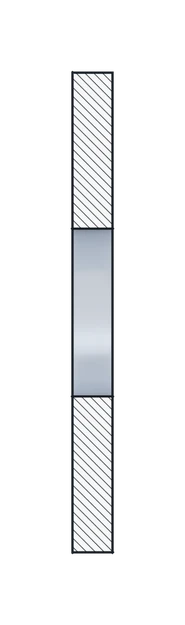
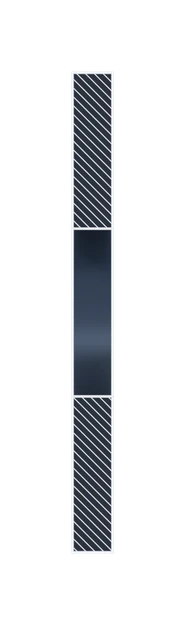
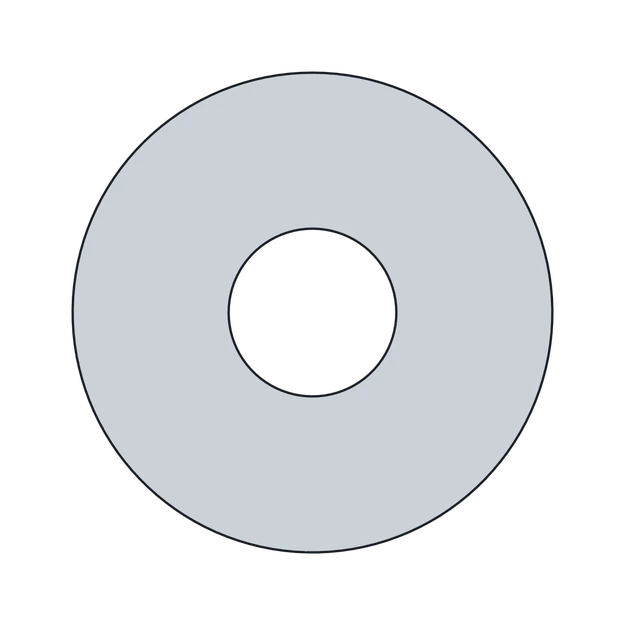

Values per ISO 7093-1:2000.Differs from DIN 9021
Verified data
We have checked this data against reliable sources.MechLab Geek accepts no liability for any use of this data or its consequences. Check it before you use it. Legal notice.Spotted a mistake? Let us know.
Calculators that use this standard: Tightening torque and screw loads · Bolted joint configurator
About DIN 9021
What it is
The plain washer of the large series: its outside diameter is about three times the thread. An M10 has the same 10.5 mm hole as DIN 125, but a 30 mm outside diameter and 2.5 mm thickness (DIN 125: 20 and 2 mm).
Where it is used
Under heads and nuts on soft or thin parts (wood, plastics, sheet metal) and over large or slotted clearance holes, where a normal washer would sink in or slip through, from M2.5 to M36.
DIN or ISO
ISO 7093-1 replaced DIN 9021. Most sizes are the same; four differ: the M5 is 1 mm thick in ISO and 1.2 mm in DIN, and M18, M20 and M24 have a hole 1 mm smaller in ISO (M20: 21 mm against 22). ISO 7093-1 starts at M3.
Typical mistakes
- Ordering by the outside diameter. The 30 mm washer is the M10 one.
- Trusting the washer alone over a large clearance hole. ISO 7093-1 asks to check its thickness there: a thin washer bends over a wide hole.
- Using a soft washer under a high-strength screw. ISO 7093-1 suits its 200 HV class to screws up to 8.8 and its 300 HV class to 10.9.
- Mixing DIN and ISO washers of M18, M20 or M24: the hole differs by 1 mm.
References
- DIN 9021:1990 Washers with outside diameter ≈ 3 × nominal thread diameter
- ISO 7093-1:2000 Plain washers — Large series — Part 1: Product grade A
- DIN 125-1:1990 Washers, product grade A, up to 250 HV, for hexagon head bolts and nuts