DIN 125-A
Plain washer,normal series
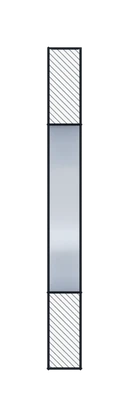
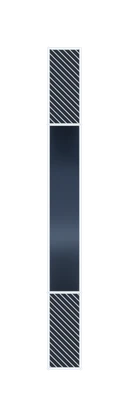
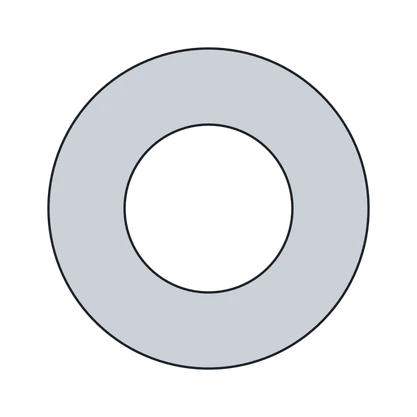

Values per ISO 7089:2000.
Verified data
We have checked this data against reliable sources.MechLab Geek accepts no liability for any use of this data or its consequences. Check it before you use it. Legal notice.Spotted a mistake? Let us know.
Calculators that use this standard: Tightening torque and screw loads · Bolted joint configurator
About DIN 125
What it is
The plain flat washer of the normal series, form A (no chamfer). It is named after the screw, not its hole: an M10 washer has a 10.5 mm hole, a 20 mm outside diameter and is 2 mm thick. From M39, DIN 125-1 gives form B (with chamfer) only, with the same sizes.
Where it is used
Under hex heads and nuts, to spread the load on soft or slotted parts and protect the surface, from M1.6 to M64.
DIN or ISO
ISO 7089 replaced DIN 125-1 form A. Up to M36 the washers are the same. Above M36, DIN 125 washers have a smaller hole and are thinner: an M42 has a 43 mm hole and is 7 mm thick, against 45 and 8 mm in ISO 7089.
Typical mistakes
- Ordering by the hole. An M10 washer is the one for an M10 screw, with a 10.5 mm hole.
- Putting a normal washer under a socket head screw in its counterbore. It needs a wider, deeper counterbore (24 × 12.8 mm for an M10), or the small series DIN 433.
- Mixing DIN and ISO washers above M36: hole and thickness differ.
References
- DIN 125-1:1990 Washers, product grade A, up to 250 HV, for hexagon head bolts and nuts
- ISO 7089:2000 Plain washers — Normal series — Product grade A
- DIN 433-1:1990 Washers, product grade A, up to 250 HV, for cheese head screws